FY 2025/26
Environmental, Social and Governance
How FCJ builds, who it supports, and how it governs carry consequences that reach well beyond its balance sheet.
FCJ's Environmental, Social and Governance framework is the formal expression of the organisation's understanding that its role extends beyond the provision of commercial and industrial space. As a public developer with a portfolio spanning 13 parishes and a mandate rooted in national economic development, FCJ's decisions about how it builds, who it supports, and how it governs carry consequences that reach well beyond its balance sheet. The ESG Policy adopted in the prior year provided the framework; 2025/26 was the year that framework was tested, applied, and in several significant respects, exceeded.
The year's defining event, Hurricane Melissa, placed every dimension of FCJ's ESG commitment under direct pressure. The organisation's response across environmental resilience, social investment, and governance accountability provides the clearest demonstration to date of what its ESG commitments mean in practice.
“Sustainability is no longer about doing less harm. It is about doing more good.”
Jochen Zeitz, former CEO of Puma
ESG Highlights — FY 2025/26
Environmental
“We do not inherit the earth from our ancestors; we borrow it from our children.”
Antoine de Saint-Exupéry
The condition of FCJ's physical assets is a direct expression of the organisation's commitment to its clients and its credibility as a public developer. A well-maintained portfolio supports tenant retention, sustains rental revenue, protects asset values, and signals to prospective clients and partners that FCJ manages what it builds. During FY 2025/26, the Property and Engineering team delivered its highest project output on record, responding to the compounded demands of a planned capital works programme, an accelerated redevelopment agenda, and the most destructive hurricane in Jamaica's recorded history, all within a single financial year.
Sustainable Design and Climate Resilience
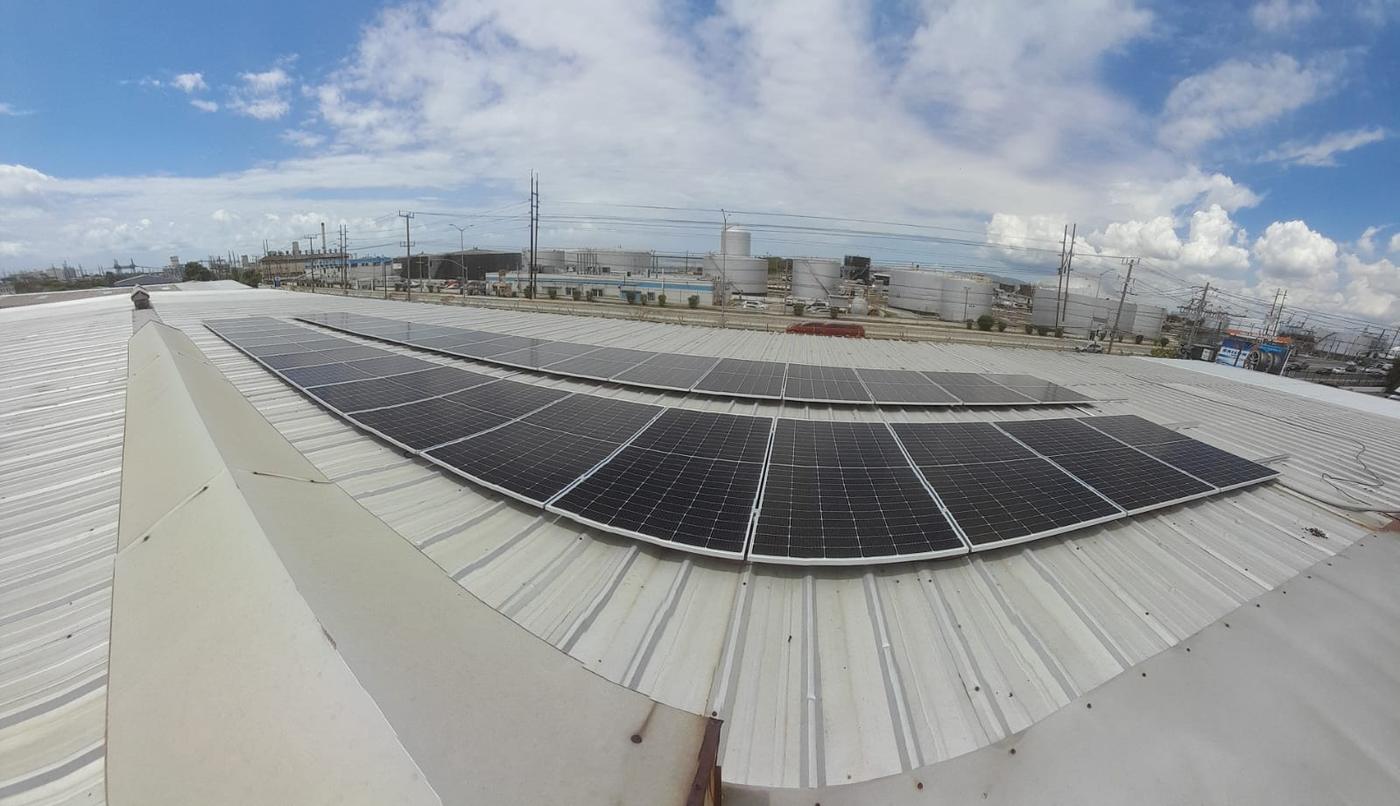
At the Garmex Free Zone, a photovoltaic grid-tied solar system was installed at the administration building, marking a practical step toward FCJ's commitment to renewable energy integration across its portfolio. Stormwater management infrastructure was also upgraded, with reconstruction of the North Boundary Wall drainage system and drainage improvements across several internal areas, reducing the site's vulnerability to the kind of flooding that Hurricane Melissa demonstrated can occur with catastrophic force.
FCJ's head architect Bryan Morris of Plexus Architects and Planners outlined the design philosophy underpinning FCJ's new developments: land use analysis informed by terrain and orientation, materials selected for durability and climate performance, and infrastructure designed specifically to manage Jamaica's increasingly intense rainfall events.
At the Morant Bay Urban Centre, a retention and detention system was engineered to channel all surface run-off into a dedicated pond before controlled discharge back to the gully system, addressing the site's large surface area and its proximity to a river. Provisions for solar photovoltaic systems, rainwater harvesting tanks, and potential wind energy supplementation have been built into the facility's design, providing the infrastructure for progressive adoption of renewable energy as technology and economics develop.
Similarly, the proposed Boundbrook Urban Centre in Portland will feature a low-rise, eco-sensitive design approach to preserve the area's environmental character and tourism appeal, with rainwater harvesting infrastructure integrated from the outset. These design decisions are guided by environmental data and long-term resilience planning, and they are increasingly standard features of FCJ's development programme.
Garmex Free Zone
Implemented a grid-tied solar system at the administration building and upgraded site-wide drainage infrastructure.
Morant Bay Urban Centre
Engineered a retention pond system and created provisions for future solar, wind and rainwater harvesting systems.
Boundbrook Urban Centre
Adopted a low-rise design to preserve Portland's character and integrated rainwater harvesting infrastructure.
Waste Management and Recycling
FCJ's partnership with Recycling Partners of Jamaica continued during the year, diverting plastic waste from FCJ sites away from landfill and into recycling facilities across the island. This programme supports FCJ's commitment under its ESG Policy to implement integrated waste management across its portfolio, with a stated goal of all properties being equipped with modern waste management facilities by 2030.
Reforestation and Green Spaces
On Saturday, March 21, 2026, a team of 16 FCJ staff volunteers participated in the Forestry Department's Forest Trek 2026, held under the theme, 'Resilience, Restoration and Recovery'. The event combined a guided forest hike in the hills of St. Thomas with a tree planting exercise in observance of International Day of Forests. FCJ's participation aligned with the Forestry Department's national programme to plant 200,000 seedlings island-wide and reinforced the organisation's commitment to reforestation as both an environmental and community resilience priority, particularly in the aftermath of Hurricane Melissa.
Governance
“It is not enough to do good; one must do it the right way.”
John Morley
Governance is the pillar that holds the other two tenets of ESG in place. Without the structures, accountability mechanisms, and oversight frameworks that good governance requires, environmental and social commitments remain aspirational rather than operational. FCJ's approach to ESG governance is built on the same principles that guide the organisation's broader corporate governance: transparency, accountability, clear lines of responsibility, and a commitment to continuous improvement.
ESG Policy and Oversight Framework
FCJ's ESG Policy provides the governance architecture within which all environmental and social activities operate. The policy is structured around three pillars and is reviewed annually to ensure alignment with emerging sustainability trends, national policy priorities, and stakeholder feedback.
The Board of Directors retains strategic oversight of the ESG framework. The policy mandates the establishment of a formal ESG Committee, tasked with setting annual targets, monitoring compliance across employees, tenants, and suppliers, conducting periodic audits, and reporting performance to the Board. Board members receive annual ESG training to ensure that governance decisions account for evolving sustainability challenges and opportunities.
ESG compliance is embedded throughout FCJ's operational relationships. Lease agreements require tenants to adopt environmentally sustainable and ethical business practices. Supplier contracts incorporate ESG compliance clauses, and non-compliance at any tier, whether employee, tenant, or supplier, is subject to a structured escalation framework ranging from advisory notices and corrective action plans through to contract termination for severe or repeated breaches.
Driven by a dedicated ESG Committee, mandatory annual training for Board members and yearly policy reviews.
ESG standards are enforced across operational relationships through lease agreements and supplier contracts.
Annual performance disclosures are audited and submitted directly to the Ministry of Finance and the Public Service.
Transparency and Accountability
FCJ's ESG Policy commits the organisation to annual ESG reporting, with performance disclosures audited and submitted to the Ministry of Finance and the Public Service. Stakeholder engagement mechanisms are maintained to ensure ongoing dialogue with employees, tenants, suppliers, and community partners. A protected whistleblower channel is being established to allow confidential reporting of ESG concerns or violations, reinforcing the accountability standards the policy requires.
FCJ's compliance with national governance frameworks, including the Public Bodies Management and Accountability Act, the Jamaica Corporate Governance Code, and relevant environmental legislation, is monitored by the Internal Audit function and the Corporate Secretary. This ensures that ESG governance is integrated into FCJ's wider compliance architecture rather than managed as a parallel obligation.
Alignment with National and Global Goals
FCJ's ESG commitments are grounded in Jamaica's Climate Change Policy Framework and Vision 2030 Jamaica, and are aligned with the goals of the Paris Agreement. As a public sector entity, FCJ is positioned to model sustainable practices that influence the behaviour of its tenants, suppliers, and partners, extending the reach of its ESG commitments into the broader industrial and commercial ecosystem it serves.
The year ahead will see FCJ deepen its ESG reporting, advance the formal establishment of the ESG Committee, and continue embedding sustainability criteria into its procurement processes, development standards, and community investment decisions, guided always by the principle that environmental and social responsibility are integral to how FCJ builds, manages, and invests.
Social
FCJ's social commitments during FY 2025/26 were shaped in large part by the demands of national recovery. The organisation's response to Hurricane Melissa gave its ESG social pillar its most demanding and most meaningful test, while its ongoing community investment programme continued to reach across parishes and sectors in support of the communities that surround and sustain its operations.
Hurricane Melissa Community Response
Acting under Cabinet Decision No. 36/25, dated November 3, 2025, FCJ was mandated to support the recovery of small businesses and communities in Whitehouse, Westmoreland, one of the parishes most severely impacted by the storm. FCJ's response unfolded in two structured phases, each guided by the principles of evidence-based intervention, transparent resource allocation, and direct accountability to the communities served.
Phase 1 — Immediate Relief
On November 10, 2025, over 60 FCJ staff volunteers travelled to Whitehouse, Westmoreland to carry out a major relief operation in the communities of Auldayr and Top Hill. Working alongside the Jamaica Constabulary Force, security personnel, and community leaders, the team distributed more than 500 care packages to approximately 1,000 residents.
Each package was assembled to address immediate household needs, containing food supplies and beverages, toiletries and hygiene products, clothing for adults and infants, bottled water, tarpaulins and zinc nails for minor structural repairs, and other critical relief items. Members of FCJ's Engineering and Property team cleared downed trees and debris from roadways, restoring vehicular access to communities that had been cut off since the storm.
Phase 2 — Small Business Recovery
Following the immediate relief phase, FCJ conducted a structured, field-based assessment of micro and small businesses in the Whitehouse community over two days in late November 2025. The assessment was led by FCJ's Chairman and Managing Director, supported by teams from Engineering, Marketing, and Client Services, and was conducted in collaboration with the Member of Parliament for Eastern Westmoreland, Dr Dayton Campbell, and Councillor Michael Jackson of the Whitehouse Division.
Seventy-five businesses were assessed using a standardised methodology that included physical site walkthroughs, structured interviews with business operators, damage categorisation against defined criteria, and consolidation of findings into a verified database to support the Board's disbursement decisions. The businesses employed a combined total of 41 workers across sectors including bars, convenience stores, restaurants, beauty shops, and retail outlets, representing the everyday economic fabric of the community.
On December 12, 2025, FCJ disbursed J$12.4 million in cash grants to qualifying businesses, with each allocation calibrated to the verified category of damage. Grants were distributed by manager's cheque with identity verification required, ensuring a transparent and auditable disbursement process.
FCJ also provided support to the national recovery effort by making two warehouses available to the Office of Disaster Preparedness and Emergency Management free of charge for three months, foregoing rental income in excess of J$1.5 million per month.
Following the assessment's finding that the Whitehouse Health Centre had been severely damaged and a temporary field health centre mobilised in its place, FCJ convened an emergency meeting with the Western Regional Health Authority and committed to allocating FCJ-owned land at Culloden Subdivision for the construction of a modern, permanent health facility to serve the community.
Community Investment and Partnerships
Beyond the hurricane response, FCJ's broader community investment programme during FY 2025/26 reached across multiple parishes and sectors.
FCJ fielded a team of 49 staff volunteers in the Sagicor Sigma Corporate Run 2026, an event that raised J$150,000,736 for the restoration of five hurricane-damaged schools in western Jamaica, supporting the return to the classroom for over 3,000 students. FCJ also participated in the Jamaica Reach to Recovery Pink Run in support of breast cancer survivors.
On May 23, 2025, FCJ's team visited the Women's Centre of Jamaica Foundation in St. Thomas as part of the annual Labour Day initiative. The team carried out infrastructure improvements including installation of disability ramp rails, window replacements for improved ventilation and safety, repainting of gates, walls, and the main building, and landscaping works across the facility grounds. The project applied FCJ's property and engineering capabilities directly in service of social need, supporting an institution that serves some of the most vulnerable young women in the parish.
Across the year, FCJ's total donation and sponsorship contributions reached J$16,748,309, supporting charities, community initiatives, and relief efforts island-wide.
Support for National Disaster Preparedness
FCJ's response to Hurricane Melissa demonstrated that its social commitments extend well beyond planned community investment. The speed with which FCJ mobilised, deploying staff volunteers, engineering teams, logistics support, and financial resources within days of the storm, represents an institutional readiness for community response that speaks to the character of the organisation and its people.